

Introduction
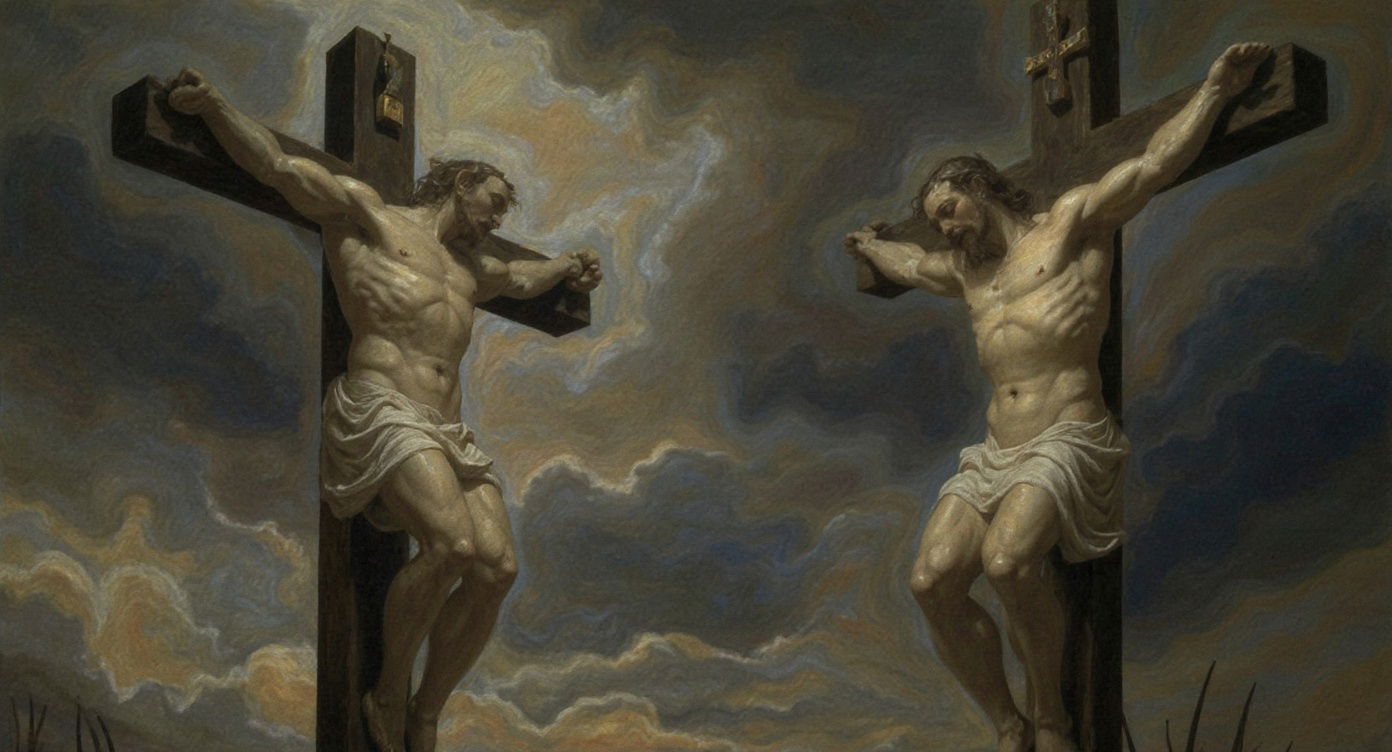
Three crosses stand against a dark sky. The crowd shouts. Soldiers laugh. Religious leaders sneer. On one cross, a criminal spits out insults. On another, a condemned man turns his head toward the suffering Christ and whispers a request that has echoed through centuries. In that moment, the story of Saint Dismas, the good thief, steps into the light.
According to Luke, this man has nothing to offer: no record of virtue, no time to make amends, no way to use his hands for good. His life is almost over. Yet from that cross he admits his guilt, defends Jesus, and dares to say, “Jesus, remember me when you come into your kingdom.” Then he hears words that no one else in Scripture hears in this exact way: “Today you will be with me in Paradise.” From the lips of Christ Himself, Saint Dismas receives a clear promise of Paradise.
We meet Saint Dismas at the lowest point of his life, yet his story gives hope to every sinner. No past is too dark. No hour is too late. His conversion opens a window onto God’s mercy, the nature of repentance, and the reality of salvation. At Crux Sancta, we care about that place where faith and reason stand together beneath the cross.
By walking through the biblical account, the harmony of the Gospels, Christ’s promise of Paradise, the Church’s reflection, and the living legacy of Saint Dismas, we gain more than an inspiring story. We find a concrete pattern for returning to God, a clearer view of Catholic teaching on salvation, and deeper trust in the Heart that welcomed a condemned thief into Heaven.
Key Takeaways
Before looking closely at the details, it helps to see the main lines of Saint Dismas’s story and why they matter.
-
Repentance Is Never Too Late: Saint Dismas shows that sincere repentance is possible even at the very end of life. One honest act of faith, at any hour, meets a God who never tires of mercy.
-
Christ’s Mercy Is Immediate: Jesus speaks of Paradise “today,” not after a long delay. This supports the Catholic conviction that God stands ready to save at the final moment of a repentant life.
-
His Words Trace Real Conversion: In the good thief we see holy fear, admission of guilt, defense of Christ, faith in His kingship, and a humble plea for mercy—exactly what the Church teaches about confession, contrition, and trust in grace.
-
His Story Guides Pastoral Care: The figure of Saint Dismas shapes preaching, prison ministry, and care for the dying. At Crux Sancta, his witness helps us join careful biblical study with very practical hope for people who feel far from God.
The Gospel Account: Encountering The Good Thief In Scripture
To understand Saint Dismas, we begin where the Church begins: with Scripture. Luke places the good thief at the center of the Passion narrative, when Jesus hangs between two criminals. The evangelist records their words in Luke 23:39–43:
“One of the criminals who were hanged railed at him, saying, ‘Are you not the Christ? Save yourself and us!’But the other rebuked him, saying, ‘Do you not fear God, since you are under the same sentence of condemnation?And we indeed justly, for we are receiving the due reward of our deeds; but this man has done nothing wrong.’And he said, ‘Jesus, remember me when you come into your kingdom.’And he said to him, ‘Truly, I say to you, today you will be with me in Paradise.’”
This brief exchange contains a full pattern of conversion:
-
Saint Dismas admits his guilt: “We are receiving the due reward of our deeds.” He does not blame others or minimize his crimes.
-
He defends Christ’s innocence: “This man has done nothing wrong,” standing up for Jesus in front of hostile onlookers.
-
He professes faith: “Jesus, remember me when you come into your kingdom,” recognizing a hidden kingship beyond the visible cross.
Luke also contrasts the two thieves. One uses his last breaths to insult Christ and demands escape from suffering: “Save yourself and us.” The other turns from self-focus to worship and entrusts his fate to Jesus. That contrast quietly asks each of us what kind of voice we bring near Christ.
Matthew and Mark mention two thieves and say that both reviled Jesus. John notes only that Jesus dies with two others. Only Luke opens a window into the soul of the penitent thief. From the cross, Christ appears as judge and savior at once, suffering and at the same time granting eternal life. The Church honors Saint Dismas as a clear sign of how mercy reaches a sinner who turns to God with empty hands.
Harmonizing The Gospel Narratives: Understanding Apparent Contradictions
Many readers notice that Matthew and Mark say both criminals insult Jesus, while Luke presents one criminal as penitent. Does that weaken trust in Scripture? The Church Fathers and many scholars see these passages as different angles on the same event rather than conflicting reports.
Origen suggests that at the start of the crucifixion both criminals join the crowd in mockery, just as Matthew and Mark state. As time passes, one of them watches Jesus pray, “Father, forgive them,” and his heart begins to soften. He moves from insult to silence, then from silence to repentance. Luke then records the words of this changed man. In that view, the good thief’s conversion unfolds in real time on the cross.
Augustine and Ambrose offer another helpful angle. They point to a figure of speech in which a writer uses the plural to describe a scene even if one person is the main speaker. Matthew and Mark describe the hostile scene around the cross using “thieves” in the plural. Luke, who often highlights God’s mercy to sinners, slows down and distinguishes the two men so we can see Saint Dismas’s conversion in detail.
Even the Greek vocabulary leaves room for harmony. Matthew and Mark use a verb that means “insulted” or “reproached,” while Luke uses a stronger term for the impenitent thief that can mean “blasphemed.” This variation can suggest different stages or degrees of hostility and allows for a change of heart in one of the men.
Placed together, the accounts give a richer picture, not a confused one. Each evangelist writes from real memory and for a real theological purpose. At Crux Sancta, we see this as a clear case where faith and careful study work together to show that Scripture tells one coherent story from different, Spirit-led perspectives.
"Today You Will Be With Me In Paradise": Unpacking Christ's Promise
At the center of Saint Dismas’s story stand the words of Jesus: “Truly, I say to you, today you will be with me in Paradise.” These words touch on time, hope, and Heaven all at once, so the Church has reflected on them with care.
Because early Greek manuscripts lack punctuation, some have wondered where the comma belongs. A small number of readers connect “today” with “I say,” giving the sense, “I say to you today that you will be with me in Paradise,” and leaving the timing open. The Catholic tradition, supported by most ancient translations and most modern scholars, reads “today” with “you will be”: “I say to you, today you will be with me in Paradise.” In this reading, Jesus promises Saint Dismas immediate entrance into blessed life after death.
Saint Thomas Aquinas notes that this Paradise is not an earthly garden but the spiritual state of the blessed who enjoy the vision of God. The good thief’s soul goes with Christ into that joy. This raises a familiar question: How can Saint Dismas enter Heaven without recorded water baptism?
Catholic teaching speaks of baptism of desire and baptism of blood. When someone desires God, repents with perfect contrition, and dies united to Christ, God can grant the grace of baptism in an extraordinary way. Hanging beside Jesus, Saint Dismas acknowledges his sin, professes faith, and clings to the crucified Lord in public. The Church sees in him a vivid example of God’s freedom to save outside the usual sacramental path.
The Catechism echoes this truth:
“God has bound salvation to the sacrament of Baptism, but he himself is not bound by his sacraments.”— Catechism of the Catholic Church, 1257
Jesus does more than comfort a dying man; He speaks almost like a canonization formula: “Today you will be with me.” For us, that means Paradise is not only a distant hope after a long process. It can begin at the very moment a repentant heart dies in God’s grace. Saint Dismas stands at the gate of that mystery, pointing us toward trust in a Savior who speaks words of life while His own life seems to be fading.
The Theological Significance: A Model Of Christian Conversion
If we step back from the drama of Calvary, Saint Dismas offers more than comfort for late conversions. His words sketch a pattern of Christian repentance that guides preaching, confession, and spiritual direction.
His response to Christ can be seen in clear steps:
-
Holy Fear: “Do you not fear God…?” He recognizes that God is just and that his life will meet that justice.
-
Admission Of Guilt: “We are receiving the due reward of our deeds.” He offers no excuses and makes no comparisons.
-
Recognition Of Christ’s Innocence: “This man has done nothing wrong.” He alone, near the cross, publicly defends Jesus.
-
Faith In Christ’s Kingship: He speaks of a “kingdom” that lies beyond the present horror, seeing royalty in a crucified man.
-
A Humble Plea: “Jesus, remember me.” He asks not for escape from his cross but for fellowship with Christ.
The impenitent thief demands a miracle on his own terms: “Save yourself and us.” Saint Dismas asks instead to be remembered by Jesus, trusting Christ’s will more than his own. His humility echoes the tax collector in the Temple:
“God, be merciful to me, a sinner!”— Luke 18:13
Catholic theology sees here the meeting of grace and human freedom. God’s grace moves the good thief as he watches Christ suffer with patience and forgive His enemies. Yet Saint Dismas still must respond. He uses his mind, his voice, and his will to accept that grace, mirroring the Church’s teaching that God never forces repentance.
His story also pairs with the parable of the laborers in the vineyard (Matthew 20:1–16). Those who arrive at the last hour receive the same wage as those who worked all day. Saint Dismas enters the “field” near sunset yet receives full pay. This is not permission to postpone conversion. It is a reassurance: if someone truly turns at the end, God does not say, “Too late.” For anyone stuck in sin, the good thief quietly witnesses that God still waits with open arms.
The Names And Legends Of The Good Thief
The Gospels never give a personal name to either man crucified beside Jesus. The familiar name “Saint Dismas” comes from later Christian tradition, especially a text known as the Gospel of Nicodemus or Acta Pilati. A fourth-century Greek version of this work calls the penitent thief Dismas and the other Gestas. Many scholars connect “Dismas” with a Greek word for “sunset,” fitting a man who meets Christ at the close of life.
Other Christian traditions preserve different names. Some Coptic texts refer to him as Demas. A Syriac account of Jesus’s childhood mentions bandits named Titus and Dumachus. A Latin source offers a name close to Zoatham, while some Russian traditions speak of Rakh. Over time, however, “Saint Dismas” became the common name for the good thief in the West.
Several legends try to fill in his earlier life. One popular tale from an infancy gospel describes two bandits who meet the Holy Family during the flight into Egypt. One robber—later identified as Saint Dismas—takes pity on the child Jesus and persuades his partner to let the family pass unharmed. Mary blesses him and foretells that mercy will reach him at the cross. Other writers, such as John Chrysostom and Gregory the Great, imagine him as a violent desert bandit, even guilty of killing his own brother.
These accounts are not part of the Bible and are not doctrine. Yet they reveal how Christians have prayed over the figure of the good thief. Whether they picture him as slightly softened or deeply hardened, the point remains the same: no sinner lies beyond the reach of Christ’s mercy, as God showed on Calvary.
Veneration, Feast Days, And Liturgical Commemoration
From early centuries, Christians have honored the good thief as a saint. In the Roman Catholic calendar, Saint Dismas is commemorated on March 25. That date already marks the Solemnity of the Annunciation, when we recall the conception of Christ in Mary’s womb. An ancient Christian tradition holds that Christ was conceived and died on the same calendar day, so this feast links His coming in the flesh with His saving death beside Saint Dismas.
The Roman Martyrology remembers “the holy thief in Jerusalem who confessed Christ on the cross and heard the words, ‘Today you will be with me in Paradise.’” In a single line, the Church brings together confession, Christ’s promise, and the place of his martyrdom.
In the Eastern Orthodox Church, Saint Dismas has a strong place in Holy Week, especially on Good Friday. A beloved hymn, often called “The Wise Thief,” praises his sudden insight and Christ’s mercy:
“The wise thief didst Thou make worthy of Paradise in a single moment, O Lord…”
Before Communion, many Orthodox believers pray, “Like the thief will I confess You; remember me, O Lord, in Your Kingdom.” Each Christian steps into the role of Saint Dismas before receiving the Holy Gifts. Oriental Orthodox traditions also honor him within their Good Friday services. Across these rites, the Church presents the good thief not as a minor figure but as a voice to imitate at the foot of the cross.
Patronage And Ministry: The Legacy Of Saint Dismas Today
The Church does not venerate saints only as figures from the past. She turns to them as intercessors for real needs. Saint Dismas, a condemned criminal who died forgiven, naturally becomes a patron for those in prison or near death.
He is widely regarded as a patron of prisoners, especially those on death row. People ask his prayers for repentant thieves, for those who work in prisons, and for men and women preparing for death. Funeral directors and those who care for the dead also look to him, since he faced his own death with faith and hope.
His name shapes many modern ministries. Dismas Ministry in the United States offers Catholic Bibles and catechetical resources to inmates and chaplains. Various Dismas House communities serve as halfway homes, helping people move from incarceration back into society with support, prayer, and accountability. Churches dedicated to the good thief, such as the Church of Saint Dismas at Clinton Correctional Facility in New York, stand as visible signs of mercy near places of confinement. Even the city of San Dimas in California carries his memory in its name.
These works echo the corporal work of mercy that calls Christians to visit the imprisoned and comfort the afflicted. They send a clear message to those behind bars: no one is written off by God. At Crux Sancta, we share that desire to join solid theological reflection with real pastoral outreach. Careful study of Saint Dismas is meant not only to inform minds but also to help hearts trust that grace can reach into the hardest places.
Artistic And Cultural Representations Of Saint Dismas
Art and story carry theology into the imagination, and Saint Dismas appears again and again in Christian art, almost always on Christ’s right side—the place of honor. Many crucifixes even tilt the head of Jesus slightly toward that side, hinting at His welcome to the penitent thief.
In Eastern iconography, the lower bar of the cross often slants. The raised end points toward the side of Saint Dismas, symbolizing his rise to Paradise, while the lower end angles toward the other thief, suggesting a fall away from grace. In icons of the Harrowing of Hell, where Christ descends to free the righteous dead, some images place Saint Dismas near Him as He leads Adam, Eve, and the prophets toward Heaven.
Early examples of this imagery can be seen on the wooden doors of the Basilica of Santa Sabina in Rome and in the sixth-century Rabbula Gospels. Later Western and Eastern art continues to show the good thief in crucifixion scenes, often with a peaceful expression that contrasts with the defiance of the other thief.
Saint Dismas has also entered wider culture. Samuel Beckett’s play Waiting for Godot includes a conversation about the two thieves and how the Gospels report them. Films and television shows allude to him through the town name San Dimas. Modern songs, novels, and even video games borrow his name or story to explore guilt, justice, and redemption. Relics associated with him—such as fragments of wood linked to his cross and preserved at places like the University of Notre Dame—remind pilgrims that Luke’s account is tied to real people and real history.
Conclusion
When all these threads are gathered, the story of Saint Dismas stands out as one of the most striking scenes at Calvary. Within a few hours, a condemned criminal moves from public shame to the promise of Paradise. He has no record of service, no time for long devotions, no chance to repair the harm he has done. He has only a clear view of his own sin, a bold confession of Christ’s innocence, and a plea for mercy. That is enough for Jesus, who speaks a promise stronger than death.
For us, this scene reveals the heart of God. No sin outweighs the price of the cross. No past closes the door, as long as life remains and a person turns toward God with a sincere heart. Saint Dismas shows what real repentance looks like: fear of God, honest admission of guilt, defense of Christ, faith in His kingdom, and a humble request to be remembered.
We can each ask where we stand beside those three crosses. Do we sometimes demand rescue on our own terms, like the impenitent thief? Or do we step into the role of the good thief, accepting the cost of our sin and resting our hope on Christ alone? For anyone burdened by shame or distance from God, his story speaks a quiet word: it is not too late to return.
At Crux Sancta, we seek to hold together this deep theology of grace with clear teaching that strengthens real lives. As we reflect on Saint Dismas, we can turn his words into our own prayer: Saint Dismas, good thief and friend of Jesus, pray for us, that we may one day hear from the lips of Christ the same promise of Paradise.
FAQs
Question 1: Was Saint Dismas Baptized? How Could He Enter Paradise Without Baptism?
The Gospels never mention a baptism for Saint Dismas, yet Jesus clearly promises him Paradise. Catholic teaching holds that while baptism with water is the normal path to salvation, God can grant its grace in extraordinary ways. The Church speaks of baptism of desire and baptism of blood, where perfect contrition and union with Christ’s sacrifice bring the fruits of the sacrament.
The Council of Trent and the Catechism of the Catholic Church affirm that God has bound salvation to the sacraments for our sake, but He is not bound by them. Saint Dismas, hanging beside Jesus, repents, believes, and entrusts himself to Christ—an ideal example of this teaching.
Question 2: Why Is Saint Dismas's Feast Day On March 25 Instead Of Good Friday?
The Church celebrates Saint Dismas on March 25 because of an ancient belief that Christ was conceived and died on the same calendar date. March 25 is already the Solemnity of the Annunciation, when the Word became flesh in Mary’s womb. Linking Saint Dismas to that day joins the mystery of the Incarnation with the mystery of Redemption. In Eastern Orthodox practice, he is remembered more directly on Good Friday within the liturgy, especially through the hymn “The Wise Thief.”
Question 3: Did Both Thieves Initially Mock Jesus, Or Only One?
Matthew and Mark state that both criminals insulted Jesus, while Luke highlights one as penitent. Many Church Fathers suggest that both initially mocked Christ, but one later had a change of heart as he watched Jesus suffer and forgive. Others point to a literary way of speaking in the plural to describe a hostile scene, even if one voice stands out. Differences in the Greek verbs—ranging from general insult to stronger “blasphemy”—also allow for stages of hostility and later repentance. Together, these readings show that the accounts fit and that the key point is the real conversion of one thief.
Question 4: What Crimes Did Saint Dismas Commit To Deserve Crucifixion?
The Gospels use a Greek word often translated as “bandit,” which usually refers to a violent robber and sometimes to a rebel against Rome. Crucifixion was reserved for serious crimes such as armed theft, murder, or revolt. Later writers imagine Saint Dismas as a harsh outlaw, even as a killer of his own brother, but these details are not part of Scripture. What matters for the Church is less the precise charge and more the depth of his guilt—and the even deeper mercy that reaches him.
Question 5: Can We Pray To Saint Dismas For Intercession?
Yes. The Church venerates the good thief as Saint Dismas, so we may ask for his prayers just as we ask those of other saints. Many people turn to him for prisoners, for those on death row, for the dying, and for anyone afraid to return to God. His own experience gives him a special closeness to people in those situations. A simple prayer might be: “Saint Dismas, who heard Jesus promise Paradise, pray for me and for all sinners, that we may trust in His mercy and never despair.”