Introduction
The first time I heard the phrase Immaculate Conception, I quietly assumed it meant the way Jesus was conceived without a human father. Many Catholics, and plenty of other Christians, make the same mistake. Only later did I learn that when the Church answers the question what is the Immaculate Conception, she is speaking about Mary’s own conception, not Christ’s.
The doctrine says that Mary, from the very first moment of her existence in the womb of her mother, Saint Anne, was preserved from original sin. God filled her soul with grace from the start, preparing her to be the Mother of His Son. Her conception happened in the normal human way through Joachim and Anne, yet God acted in a hidden, astonishing way in her soul.
This teaching matters because it shows how carefully God prepared for our salvation. Mary is not an optional “extra” in the story of Christ. She is the New Eve, the woman whose yes to God stands where Eve’s no once stood. When we understand what the Immaculate Conception is, we see more clearly both the greatness of Jesus the Savior and the depth of God’s mercy at work in one of His creatures.
In this article, I walk through the scriptural roots of this dogma, the theological reasoning behind it, the long road from early belief to formal definition, and what it means for prayer and daily life. At Crux Sancta, we try to bring serious theology down to earth, so that Scripture, Tradition, and philosophy speak to the heart as well as the mind. By the end, I hope this teaching on Mary’s grace will lead to deeper love for Christ, who saved her—and us—in the most wonderful way.
Key Takeaways
Before diving deeper, I want to sketch the main points that guide everything that follows. These short notes can serve as a quick reference and a simple way to check whether we really grasp what the Immaculate Conception means.
-
The Immaculate Conception refers to Mary’s own conception in Saint Anne’s womb, when God preserved her from original sin from the first instant of her existence. It does not describe the virginal conception of Jesus, which is a different doctrine about His birth by the Holy Spirit.
-
Mary’s preservation from sin is a form of preservative redemption, in which Christ’s saving merits reach her in advance. She is not outside redemption; she is redeemed more perfectly, by being kept from the fall rather than raised up afterward.
-
The dogma rests on Scripture read in the Church: Gabriel’s greeting “full of grace” in Luke 1:28, the “enmity” between the woman and the serpent in Genesis 3:15, and Old Testament figures like the Ark of the Covenant all point toward Mary’s special grace.
-
Pope Pius IX formally defined this teaching as dogma on December 8, 1854, in the constitution Ineffabilis Deus, and four years later Mary confirmed it at Lourdes when she told Saint Bernadette, “I am the Immaculate Conception.”
-
Understanding what the Immaculate Conception is deepens our sense of God’s wisdom and love and shows how Mary’s free cooperation with grace is meant to mirror, in a humble way, the holiness to which we are all called.
What Is The Immaculate Conception? Defining The Doctrine
When we ask what is the Immaculate Conception in clear, Catholic terms, the Church answers with a very precise statement:
“The most Blessed Virgin Mary, in the first instance of her conception, by a singular grace and privilege granted by Almighty God, in view of the merits of Jesus Christ, the Savior of the human race, was preserved free from all stain of original sin.”— Pope Pius IX, Ineffabilis Deus
From the first instant she existed, her soul was filled with sanctifying grace.
The word “immaculate” means “without stain.” In this case, the stain is original sin, the wound we all inherit from Adam and Eve. Original sin is not a personal fault we commit, but the absence of the life of grace with which God intended to clothe the human soul—a concept explored in depth in studies on children's spiritual development. It leaves our nature weakened, our desires disordered, and our relationship with God broken from the start.
Mary is the one exception to this rule among the descendants of Adam. When God created her soul and joined it to her tiny body in Saint Anne’s womb, He did something new. Instead of allowing her to share the wounded state we are born with, He poured His life into her soul at that first instant. She never knew a moment when she was not God’s beloved daughter, filled with His grace.
It is just as important to say what the Immaculate Conception is not:
-
It is not the Virgin Birth of Jesus.
-
Mary was conceived in the normal physical way by her parents, Joachim and Anne.
-
Jesus, on the other hand, was conceived in Mary’s womb by the power of the Holy Spirit without a human father.
The Immaculate Conception concerns Mary’s spiritual condition at her conception, not a miraculous physical event.
Why would God do this? The Church answers that it was fitting that the woman chosen to bear the Son of God should be a “pure and unblemished vessel.” God was preparing the living Ark of the New Covenant that would carry His eternal Word. Yet we must remember that this grace was not something Mary earned in advance. It was entirely God’s gift, given because of Christ’s future sacrifice and ordered toward her mission as Mother of God.
The Biblical Foundations: Scripture And The Immaculate Conception
The phrase “Immaculate Conception” never appears in the Bible, and the Church does not claim that it does. Yet when I read Scripture with the mind of the Church, I start to see how the question what is the Immaculate Conception reaches into some of the deepest currents of biblical revelation.
The clearest passage is the angel Gabriel’s greeting at the Annunciation in Luke 1:28. He does not simply say “Hail, Mary.” He addresses her with a title: kecharitomene, usually translated “full of grace.”
“Hail, full of grace, the Lord is with you.”— Luke 1:28
This Greek word is a perfect passive participle. That grammar points to an action completed in the past with effects that remain in the present. In simple terms, Gabriel is not announcing a new gift only at that moment, but recognizing a state that has already been given and continues.
If Mary is already “full of grace” before conceiving Jesus, and that fullness stretches back into her past, then her grace-filled state reaches all the way to the beginning of her life. She is not just momentarily graced; she is marked by a lasting, exceptional relationship with God. Catholic theology sees here a scriptural window into the mystery of her conception without sin.
Another key passage is Genesis 3:15, sometimes called the Protoevangelium, or “first Gospel.” After the fall of Adam and Eve, God speaks to the serpent and promises, “I will put enmity between you and the woman, and between your offspring and hers.” The Church reads this as a prophecy not only of Christ, the offspring who crushes the serpent, but also of Mary, the woman who stands in total opposition to Satan.
This “enmity” is not half-hearted. It is complete, a steady opposition between the woman and the serpent with no shared ground. If Mary ever fell under the rule of sin, even for an instant, this perfect enmity would be broken. Her complete opposition to the enemy suggests a life that never lay under his rule, which again points toward the grace of the Immaculate Conception.
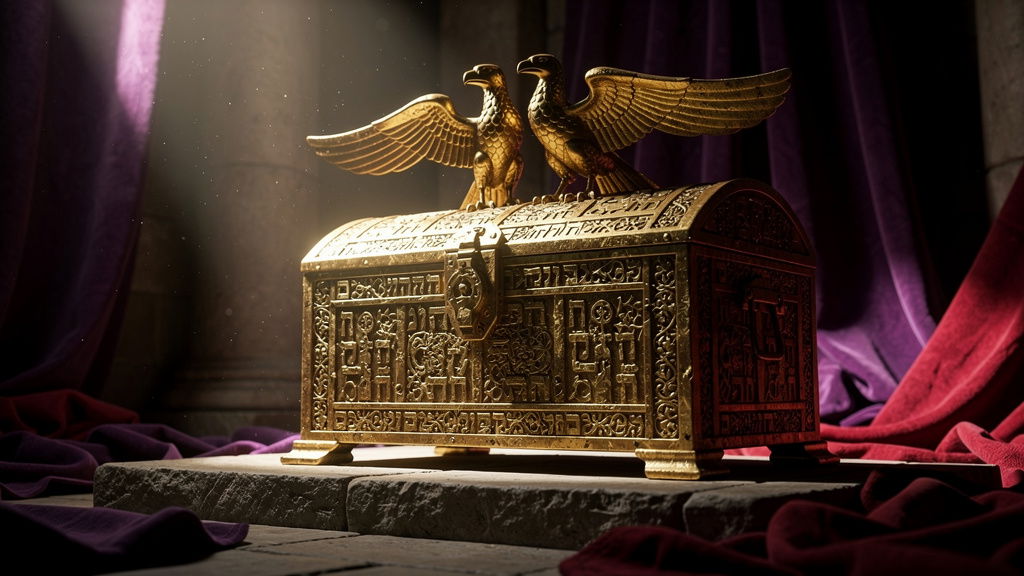
Old Testament images deepen this pattern. Ineffabilis Deus highlights the Ark of the Covenant, made of incorruptible wood and overlaid with pure gold, set apart to carry the manna, the tablets of the Law, and Aaron’s rod. If this inanimate ark was fashioned so carefully to hold these sacred signs, it seems fitting that the living Ark who would carry the living Bread from heaven, the eternal Word, and the true High Priest would be prepared in an even purer way. Mary, as that Ark, is fittingly preserved from the corruption of sin.
Sacred Tradition plays a vital role here. The early Church Fathers, meditating on these texts, saw Mary as the New Eveand the Ark of the New Covenant. They did not read Scripture as isolated individuals, but as members of the living Body of Christ. Guided by the Holy Spirit, the Church gradually came to recognize that the grace hinted at by Gabriel’s greeting and the Protoevangelium is nothing less than the mystery of Mary’s conception without sin, passed on to us through Scripture and Tradition together.
Preservative Redemption: How Mary Was Saved By Christ
A common concern arises as soon as we start to define what the Immaculate Conception is. If Mary was free from original sin, did she still need Jesus to be her Savior? At first glance, it might seem that a sinless person has no need of redemption.
This problem weighed on many theologians during the Middle Ages. The Church firmly taught that Christ is the one Redeemer of all. No human being, including Mary, could stand outside His saving work. If the doctrine of the Immaculate Conception seemed to cut her off from the rest of fallen humanity, that would be a serious mistake.
Blessed John Duns Scotus, a Franciscan theologian, offered the insight that helped the Church move forward. He proposed that Mary was indeed redeemed by Christ, but in a special way he called preservative redemption. Instead of being cleansed after falling into sin, she was preserved from falling in the first place, by the anticipated merits of Christ’s Passion.
An image often used here is very simple:
-
Imagine one person falls into a deep, muddy pit, and a rescuer pulls that person out. The rescuer has saved the victim.
-
Now imagine a second person walking toward the same pit. Just at the edge, the rescuer catches hold and keeps that person from falling in at all. This second person is also saved by the rescuer, but in an even better way, without ever being covered in mud.
Mary is like that second person. Left to herself, as a daughter of Adam, she would have shared in original sin as we do. Instead, God applied the saving power of Christ’s future sacrifice to her at the moment of her conception. She truly needed a Savior, and she rejoices in “God my Savior,” as she says in Luke 1:47, precisely because He saved her in so excellent a way.
This idea also helps answer Romans 3:23, where Saint Paul says, “all have sinned and fall short of the glory of God.” The Church understands this as a general statement about the human condition, not as a list without any possible exceptions. Jesus is the clearest exception, and infants who die before personal sin offer another. Mary is an exception by special grace, not by her own effort.
The Catechism sums this up by saying that Mary was “redeemed in a more exalted fashion, by reason of the merits of her Son” (CCC 492).
“What the Catholic faith believes about Mary is based on what it believes about Christ, and what it teaches about Mary illumines in turn its faith in Christ.”— Catechism of the Catholic Church, 487
Far from lessening Christ’s saving work, the Immaculate Conception shows its power. His grace does not only raise up sinners from a fall; it can also keep one chosen person from falling at all.
From Belief To Dogma: The Historical Path
The definition of the Immaculate Conception in 1854 did not appear out of thin air. When I look back through Christian history, I see a long story in which the Church prays, believes, argues, and slowly comes to speak more clearly about what God has done in Mary.
In the early centuries, the Fathers did not use the exact phrase “Immaculate Conception,” but they spoke warmly of Mary’s holiness. They called her the New Eve, drawing a contrast between Eve’s disobedience and Mary’s faithful obedience. Saint Justin Martyr and Saint Irenaeus saw Mary’s yes as undoing Eve’s knot of sin.
“The knot of Eve’s disobedience was loosed by the obedience of Mary.”— Saint Irenaeus of Lyons
Saint Ephrem the Syrian praised Christ and His mother as entirely free from stain, writing that there was “no spot in Thee, O Lord, nor any taint in Thy Mother.”
As devotion grew, liturgical feasts began to appear, including a celebration of Mary’s conception that spread from the East to the West by the 11th century. Once the Church began to celebrate this mystery in her prayer, theologians had to ask hard questions about how it related to original sin and redemption. This led to heated discussion, especially between members of the Dominican and Franciscan orders.
Some great thinkers, such as Saint Bernard of Clairvaux and later Saint Thomas Aquinas, hesitated to affirm the Immaculate Conception. Their concern was not a lack of love for Mary, but a deep reverence for Christ’s universal saving role. They feared that saying Mary never shared in original sin might imply that she did not need Christ as Redeemer.
The Franciscan John Duns Scotus, as we saw earlier, answered this concern with his teaching on preservative redemption. His simple line, often quoted in Latin—Potuit, decuit, fecit (“He could do it, it was fitting that He do it, so He did it”)—captured the growing sense that God had in fact acted in this fitting way toward Mary. Over time, Scotus’s view gained wide support.
Devotion among the faithful also grew strong. In 1830, Mary appeared to Saint Catherine Labouré in Paris and asked that a medal be struck with the words, “O Mary, conceived without sin, pray for us who have recourse to thee.” The Miraculous Medal spread rapidly, and the faith of simple Christians pressed the Church to speak more clearly.
Before defining the dogma, Pope Pius IX consulted bishops around the world, asking whether they believed this doctrine and whether it should be formally defined. Receiving overwhelming support, he proclaimed the dogma in Ineffabilis Deuson December 8, 1854. He declared that Mary, “in the first instance of her conception,” was preserved free from all stain of original sin by a singular grace granted in view of Christ’s merits.
Just four years later, in 1858, a poor young girl named Bernadette Soubirous met a “beautiful lady” in a grotto at Lourdes. When Bernadette asked her name, the lady replied, “I am the Immaculate Conception.” This simple sentence from Mary herself deeply confirmed for many believers what the Church had solemnly taught.
The doctrine of the Immaculate Conception does not stay locked in theology books. It breathes through the Church’s prayer, feasts, and art, so that we not only know what the Immaculate Conception is in the mind, but also honor it with the heart and senses.
Every December 8, the Church celebrates the Solemnity of the Immaculate Conception. This feast falls nine months before the Nativity of Mary on September 8. In many places, including the United States, it is a holy day of obligation, and it holds special importance because Mary under this title is the country’s patroness. The date comes during Advent, which makes the feast feel like the first streak of dawn before the rising sun of Christmas.
In the liturgy for this day, ancient prayers praise Mary’s purity. The antiphon Tota pulchra es, Maria declares that she is “all beautiful” and free from the original stain. Hymns such as Ave Maris Stella and the well-loved “Immaculate Mary” draw minds and hearts toward her as the humble woman prepared by God for His Son. Praying the Rosary, especially the Joyful Mysteries, helps us reflect on how her grace-filled beginning flows into her yes at the Annunciation and her care for Christ’s hidden life.
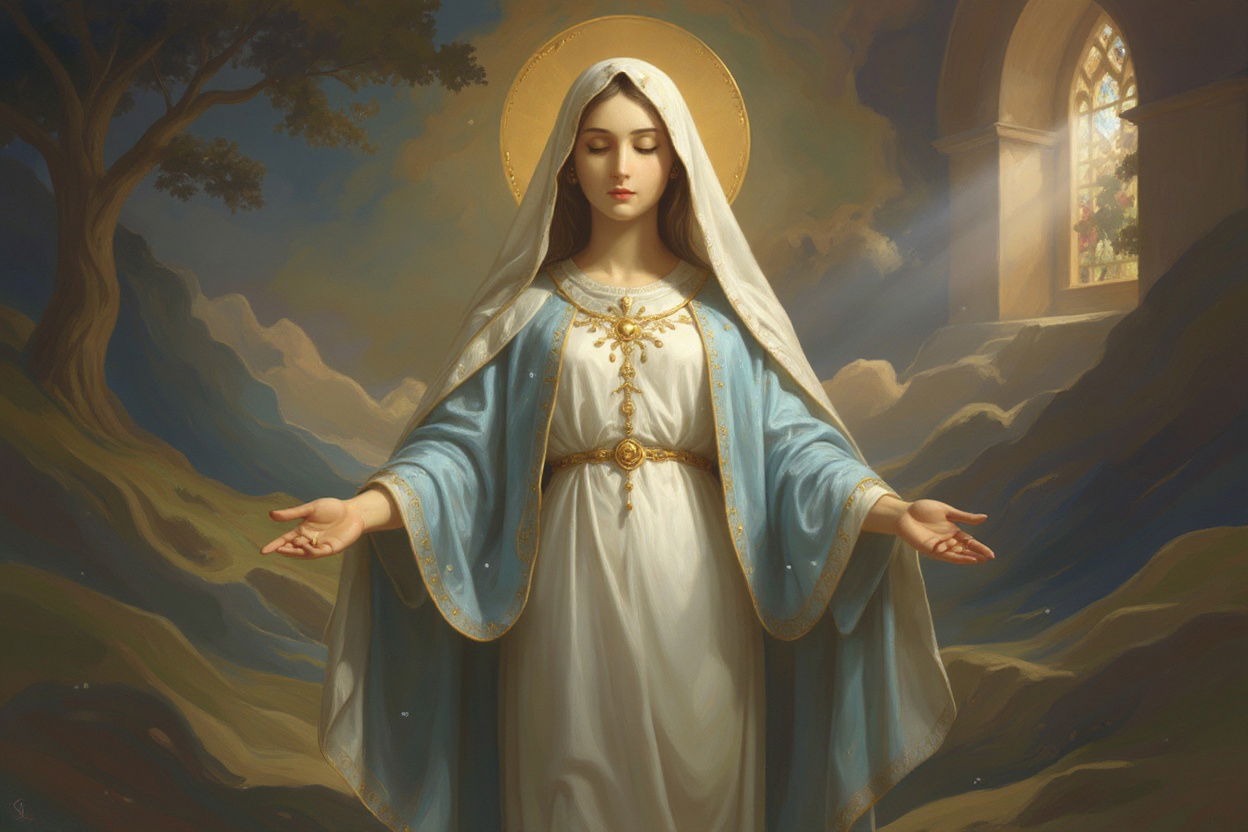
Sacred art also teaches. Over centuries, a standard image for the Immaculate Conception took shape, especially through the work of the Spanish painter Francisco Pacheco in the 17th century. In this image, Mary appears as a young girl, clothed in a white robe and blue mantle. She stands upon a crescent moon, with a serpent crushed under her feet, while a crown of twelve stars circles her head.
This scene echoes the “woman clothed with the sun” in Revelation 12:1. The white robe points to purity, the blue mantle to heaven, the stars to her royal dignity, and the serpent underfoot to her share in Christ’s victory over Satan. Artists such as Murillo, Velázquez, and Zurbarán spread this image across the Catholic world. Through these paintings, ordinary believers have learned, often without words, what the Immaculate Conception means for Mary’s place in God’s plan.
Understanding Other Christian Perspectives On The Immaculate Conception
Because the Immaculate Conception touches on original sin, grace, and Church authority, it is not surprising that Christians outside the Catholic Church often see it differently. When I listen carefully to their views, I find that clear understanding can open space for respectful conversation.
Broadly speaking:
-
Eastern Orthodox Churches honor Mary deeply. They call her Theotokos (God-bearer) and Panagia (All-Holy), and they celebrate many feasts in her honor. Yet they do not accept the dogma of the Immaculate Conception as defined in the West. A major reason is that Eastern theology speaks of the fall more in terms of death and corruption than inherited guilt. From that point of view, the Latin way of talking about original sin and Mary’s preservation from it seems unnecessary.
-
Oriental Orthodox Churches vary. The Ethiopian and Eritrean Orthodox Tewahedo Churches hold beliefs close to the Immaculate Conception and even keep a feast related to it. The Coptic and Syriac Orthodox Churches, however, do not accept the doctrine as Catholics express it.
-
Most Protestant communities reject the Immaculate Conception. Guided by the principle of sola scriptura—Scripture alone as the rule of faith—they object that this teaching is not spelled out directly in the Bible. Many also cite passages such as Romans 3:23 and see Mary as a sinner saved by grace just like every other believer. They often regard the dogma as a sign of papal overreach.
-
Within Anglicanism, there is a range of views. The Anglican Communion does not officially teach the Immaculate Conception, but some Anglo-Catholics accept it as a devotion in harmony with Catholic tradition, even if not required.
At Crux Sancta, we think it is important to hear these views fairly and to answer them with patience. When we place Scripture, Sacred Tradition, and the Magisterium side by side, we can see how the Catholic Church reads the Bible in continuity with the Fathers and how she comes, over time, to speak with clarity about mysteries like this one. Honest dialogue grounded in love for Christ can help us explain why we believe what we do and listen well to others in return.
Living The Truth: What The Immaculate Conception Means For Your Faith
It is easy to treat the Immaculate Conception as a beautiful but distant idea. Yet when I pause and ask not only what is the Immaculate Conception but also what it means for my own life, the doctrine starts to feel much closer.
Mary’s sinless beginning shows what human nature looks like when it is filled completely with God’s grace. She is not a cold statue, but a living person whose heart listens perfectly to God. Her simple word fiat—“Let it be done to me according to your word”—is the natural fruit of a soul unburdened by sin. In her, we see the pattern of the holiness to which every Christian is called.
This does not mean we should feel discouraged because we were not conceived without sin. Instead, we can see in Mary a sign of hope. God’s grace that filled her from the first instant is the same grace He offers us through Baptism, the sacraments, and daily prayer. Though we struggle with weakness and fall into sin, He can heal and strengthen us more than we often expect.
You might find it helpful to:
-
Ask Mary, conceived without sin, to intercede for purity of heart in your own life.
-
Pray the Rosary slowly, lingering over the Joyful Mysteries and Mary’s yes at the Annunciation.
-
Mark December 8 by going to Mass and making a simple act of consecration to Jesus through Mary, following the example of saints like Maximilian Kolbe.
Devotion to Mary under the title of the Immaculate Conception can renew our desire for holiness. Many saints encouraged consecration to the Immaculata, a simple act of handing one’s life over to Jesus through Mary. By trusting ourselves to her motherly care, we ask her to pray that our hearts may be more open to grace, more ready to say yes in small and large things alike.
At Crux Sancta, we try to help this doctrine move from page to prayer. When we meditate on Mary’s grace, especially by praying the Rosary or attending Mass on December 8, we are reminded that God’s plan for us is not shallow. He wants to make us saints. Mary, conceived without sin, stands before us as both a sign of His power and a mother who intercedes for our growth in holiness.
Conclusion
When I gather these threads together, I see the Immaculate Conception as a clear window into God’s wisdom and tenderness. By preserving Mary from original sin at the first moment of her existence, He prepared a pure dwelling place for His Son and revealed how deeply His grace can penetrate a human life.
Scripture, read with the eyes of the Church, hints at this mystery in Gabriel’s greeting “full of grace,” in the woman at enmity with the serpent, and in the Old Testament figures that foreshadow Mary. Tradition and the Magisterium, especially in Ineffabilis Deus, gave a firm voice to what Christians had long honored in prayer and devotion. Rather than lessen Christ’s saving work, this dogma displays its strength, since it shows Him redeeming Mary in the highest way.
Mary’s Immaculate Conception is entirely a gift. She has nothing to boast of before God; everything in her points back to Christ. When I ponder this, I feel drawn to deeper study and, even more, to deeper trust in grace working in my own life. I invite you to keep December 8 with special care, to ask Mary conceived without sin to pray for you, and to explore further resources from Crux Sancta that unite solid Catholic teaching with prayerful reflection.
O Mary, conceived without sin, pray for us who have recourse to thee.
FAQs
Question 1: Is The Immaculate Conception The Same As The Virgin Birth?
No, they are two different teachings. The Immaculate Conception refers to Mary being conceived free from original sin in the womb of her mother, Saint Anne. The Virgin Birth refers to Jesus being conceived in Mary’s womb by the power of the Holy Spirit without a human father. Confusing these doctrines is very common, but they focus on different persons and different moments.
Question 2: Why Do Catholics Believe Mary Needed To Be Without Sin?
Catholics see it as fitting that the woman chosen to be the Mother of God should be completely holy. In the Old Testament, the Ark of the Covenant that carried the manna and the tablets of the Law was made from precious materials and set apart. If that ark was treated with such reverence, it seems right that Mary, who would carry God Himself in her womb, be even more pure. This holiness was God’s free gift to her, not something she produced on her own.
Question 3: Where Is The Immaculate Conception In The Bible?
The Bible does not use the term “Immaculate Conception,” but it lays foundations that the Church later recognized more clearly. In Luke 1:28, Gabriel greets Mary as kecharitomene, often translated “full of grace,” a word form that suggests a lasting state of grace reaching back before the Annunciation. In Genesis 3:15, God speaks of a woman in constant enmity with the serpent, which points to someone never under the rule of sin. The Church reads these and other passages through Sacred Tradition, in the same way she comes to recognize teachings like the Trinity, which is also not named explicitly in Scripture but is clearly taught there.
Question 4: Does Being Sinless Make Mary Equal To God?
No, sinlessness does not make anyone divine. Adam and Eve were created without sin, yet they were only creatures. Angels were also created sinless, and the souls of the saints in heaven are perfected and free from sin. None of these are equal to God. Sin is not part of what it means to be human; it is a wound. Mary’s sinlessness simply shows what a human person can be when grace fills the soul completely and the will freely cooperates with God.
Question 5: When Did The Catholic Church Officially Declare This Doctrine?
The Church formally defined the Immaculate Conception as dogma on December 8, 1854. Pope Pius IX did this in the apostolic constitution Ineffabilis Deus, after consulting bishops from around the world and hearing their strong support. He did not create a new belief but confirmed one that had grown in the Church’s prayer and teaching for many centuries. Four years later, in 1858, Mary appeared to Saint Bernadette at Lourdes and said, “I am the Immaculate Conception,” which many Catholics saw as a moving confirmation of this dogma. December 8 is now kept as a major feast and holy day in honor of this mystery.