


Introduction
Imagine walking out of the confessional with real peace. The mortal sin is forgiven, grace is restored, yet an uneasy question still lingers: if God has forgiven the sin, why does the Church talk about purification, temporal punishment, and something called a plenary indulgence?
For many, indulgences are one of the most misunderstood parts of Catholic teaching. Some think of money and the Middle Ages. Others assume they are a kind of spiritual “cheat code” or a way to skip Purgatory without real conversion. When we look at actual Church teaching, though, we find something far more beautiful and far more serious than the stereotypes.
In this guide, we walk step by step through what a plenary indulgence really is, using the Catechism of the Catholic Church, Canon Law, Scripture, and the wisdom of the saints. We look at the difference between guilt and consequence, eternal and temporal punishment, and why the Church speaks about Purgatory at all. Then we turn to the practical side: the four conditions, the interior disposition, concrete works that carry a plenary indulgence, and how to offer them for the dead.
At Crux Sancta, we care about careful theology that still speaks to the heart. Our aim is to bring together sound scholarship and clear, simple teaching so that this doctrine does not stay abstract. By the end, the hope is that this teaching will not only make sense, but will also invite a deeper love for God, the Church, and the communion of saints.
Key Takeaways
Before going into the details, it helps to have a short map of where we are headed. These points give a quick overview of what we will explore and how the pieces fit together.
-
A plenary indulgence is the complete remission of all temporal punishment due to sins whose guilt has already been forgiven. It deals with the after-effects of sin rather than with guilt itself and presupposes that we already live in God’s grace through confession.
-
To gain a plenary indulgence, four conditions must be met: sacramental confession, Holy Communion, prayer for the intentions of the Pope, and a real, interior detachment from all sin, even venial sin. If this detachment is not complete, the indulgence is partial rather than plenary.
-
The grace of an indulgence flows from the Treasury of the Church, which is the infinite merits of Christ joined with the superabundant merits of Mary and the saints. Through the communion of saints, these spiritual riches can be applied to us.
-
Any indulgence, plenary or partial, can be applied either to oneself or offered for the souls in Purgatory, but never for other living persons on earth. This makes indulgences a powerful work of mercy for the dead.
-
To understand indulgences well, we need to distinguish eternal punishment (Hell, remitted in confession) from temporal punishment (purification from the lingering disorder of sin, completed in this life or in Purgatory).
What Is a Plenary Indulgence? The Official Catholic Definition
When the Church speaks about an indulgence, it uses very precise language. The Code of Canon Law (canon 992) and the Catechism of the Catholic Church (1471) describe an indulgence as:
“A remission before God of the temporal punishment due to sins whose guilt has already been forgiven…”— Catechism of the Catholic Church, 1471
This is not a side teaching. It fits inside the larger doctrine of sin, grace, penance, and the communion of saints.
We need to notice two parts of that definition:
-
The guilt of the sin is already forgiven, above all in the Sacrament of Reconciliation.
-
Something still remains even after that forgiveness, which the Church calls temporal punishment.
An indulgence does not forgive sin; it addresses this remaining consequence. In simple terms, confession heals the break with God and saves us from Hell, while indulgences help clear away the remaining disorder that would be cleansed in Purgatory.
The Church also teaches that she acts as “minister of redemption”. Christ alone, by his Passion, Death, and Resurrection, has earned every grace we receive. The Church does not replace him; she hands on what he has won. Because we are united in his Mystical Body, the merits of Christ, together with the merits of Mary and the saints, form a spiritual treasury. From this treasury, the Church applies grace for the remission of temporal punishment when certain acts are done with the right heart.
It is just as important to see what an indulgence is not. It is not permission to sin, not a sale of grace, and not a way to skip confession. There are two basic kinds:
-
A plenary indulgence removes all temporal punishment due at that moment.
-
A partial indulgence removes some of it.
Both are real gifts of mercy, but a plenary indulgence has a high spiritual bar, especially in the requirement of full detachment from sin.
The Broken Window Analogy: Understanding Guilt vs. Consequence

A simple way to picture the difference between guilt and temporal punishment is the broken window story.
-
A child throws a ball and breaks the neighbor’s window.
-
The child, ashamed, apologizes. The neighbor forgives and their friendship is restored.
-
Yet the glass is still broken. The cold air still comes in. Forgiveness did not put the window back.
In that moment, the guilt is gone and the relationship is healed, but the house still needs repair. That need for repair is like temporal punishment, the remaining disorder that flows from sin even after forgiveness.
Now imagine the child tries to pay for the window by doing chores. The parent sees this, then decides to cover the full cost from the family’s savings. Justice is satisfied, the window is fixed, and the friendship is even clearer. In the spiritual order, an indulgence is like that parent’s help. The Church, drawing from the treasury of Christ and the saints, offers the “payment” needed to repair the harm that sin has done.
This image shows how God’s mercy and justice work together. Mercy forgives the sinner and restores friendship. Justice asks that the disorder of sin be healed and that attachments to sin be purified. By means of indulgences, God allows his Church to apply Christ’s merits to our need for purification, so that we are ready for full friendship with him.
The Two Consequences of Sin: Eternal and Temporal Punishment
Every sin carries two kinds of consequence:
-
Eternal punishment, which concerns our final destiny with or without God.
-
Temporal punishment, which concerns the healing and purification needed after sin has been forgiven.
If we confuse these, indulgences will either seem unnecessary or will be mistaken for a way around judgment.
Mortal sin, freely chosen in grave matter with full knowledge, cuts us off from sanctifying grace. That loss is what we call eternal punishment. If we die in that state, we freely choose separation from God forever. Confession restores us to life by the power of Christ, so the guilt is taken away and the eternal punishment is removed.
Yet even when God forgives, we can still carry the habits, attachments, and wounds caused by sin. Someone who has confessed years of lying or gossip is forgiven, but may still slide into old patterns. Other people may still be hurt, reputations may be damaged, and the heart may still be self-centered. All of this shows that a “mess” remains. This is what the Church calls temporal punishment.
Temporal punishment is not God “getting even” with us. It is the name for the real work of healing that must happen in our soul and in the Body of Christ. That healing can take place here through prayer, fasting, works of mercy, patient acceptance of suffering, and indulgences. If that purification is not complete at death, it is finished in Purgatory.
Eternal Punishment: The Death of the Soul
Eternal punishment is the most serious effect of sin. It means full and final separation from God, which the Church calls Hell. Mortal sin chooses, in a serious matter, a created good over the Creator with clear knowledge and free will. Since God is the source of all life, cutting ourselves off from him is like cutting a branch away from the tree. It leads to spiritual death.
God does not desire this fate for anyone. That is why Christ gave the Sacrament of Reconciliation to his Church. When we confess mortal sins with real sorrow and a firm purpose of amendment, the priest, acting in the person of Christ, gives absolution. In that moment, the guilt is forgiven and the eternal punishment is taken away. The soul is brought back into a state of grace.
Indulgences do not deal with this eternal punishment at all. Only confession, joined with true contrition, removes that. If we think of indulgences as a way to escape Hell, we misunderstand them. They are a gift for those who have already turned back to God and received his pardon.
Temporal Punishment: The Lingering Disorder of Sin
Temporal punishment refers to what remains in and around us after the guilt of sin has been forgiven. Sin does not only break a rule; it bends the heart. It leaves behind:
-
Attachments to created things
-
Habits of selfishness
-
Wounds in relationships and in the Church
For example, a person may confess a long pattern of anger. God truly forgives, yet impatience and harsh reactions still appear. The will still leans toward the old fault, even though the person does not want to offend God. That leaning is part of the temporal effect of sin.
This purification can happen:
-
In this life, through prayer, penance, fasting, almsgiving, works of mercy, and indulgences.
-
After death, in Purgatory, if some disorder still remains.
Older manuals once spoke of partial indulgences in “days” or “years.” Many thought this meant a certain number of days less in Purgatory. In fact, those numbers referred to comparisons with ancient public penances, not to literal time after death. Because this caused confusion, the Church no longer uses that language. She now simply speaks of a partial indulgence as removing “some” temporal punishment, leaving the full measure to God’s wisdom.
The Role of Purgatory and the Need for Purification
Purgatory fits naturally into this picture of sin and mercy. The Church teaches that those who die in God’s grace and friendship, yet still need purification, undergo a final cleansing before they enter Heaven.
“All who die in God’s grace and friendship, but still imperfectly purified, are indeed assured of their eternal salvation; but after death they undergo purification, so as to achieve the holiness necessary to enter the joy of heaven.”— Catechism of the Catholic Church, 1030
Purgatory is not a second chance for those who rejected God. Everyone there is saved and will see God face to face. It is a state of hope, even though it involves real suffering.
The suffering of Purgatory is best understood as the pain of love not yet fully pure. The soul longs for God completely, yet still carries traces of imperfect love. That gap is painful, yet it is a healing pain. God burns away every attachment that does not fit his holiness.
Indulgences relate directly to this need for purification. When we gain an indulgence, especially a plenary indulgence, God applies the merits of Christ and the saints to our temporal punishment. Some or all of the purification that would have taken place in Purgatory can instead be completed here through grace. This does not remove the call to conversion or penance. It deepens it, by uniting our efforts with the merits of Christ in a special way.
The Treasury of the Church: The Source of Indulgences
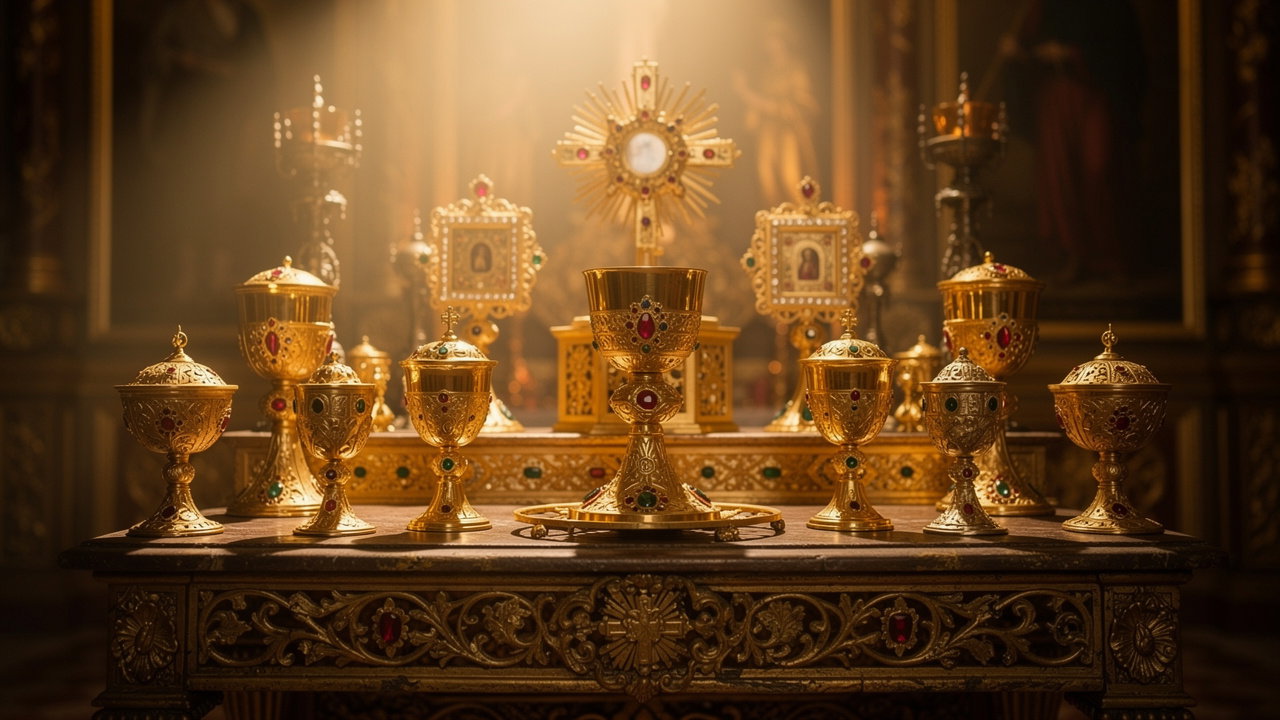
The doctrine of indulgences rests on another rich truth: the Treasury of the Church. This is not a storehouse of money or earthly goods. It is the name the Church gives to the spiritual riches that Christ and his saints possess before the Father. Since we are bound together in one Mystical Body, these riches can be shared.
At the center stands Jesus Christ, true God and true man. His Passion, Death, and Resurrection have infinite value. Every act of love in his earthly life carries endless worth. Because of this, the treasury is rooted first and foremost in him.
Alongside Christ, we find the Blessed Virgin Mary and the saints. Mary, preserved from sin and full of grace, offered her whole life in perfect union with her Son. The saints, in different times and places, offered prayers, good works, and sufferings with deep charity. God accepted these offerings and allowed them to have value beyond the lives of the saints themselves. Joined to Christ, these merits form a treasury that will never be exhausted.
The Infinite Merits of Christ and the Saints
Christ’s merits stand at the heart of the treasury. Because he is both divine and human, his loving obedience on the Cross has infinite weight. One act of love from him is greater than all the sins of the world. When we speak of his infinite merits, we mean there is no limit to the grace that can flow from his sacrifice.
Mary and the saints share in this mystery in a subordinate way. Their prayers, sacrifices, and daily faithfulness were all united to Christ. As members of his Body, their merits are not separate from his but shine with his light. Scripture speaks of the Body of Christ made up of many members, each sharing spiritual goods with the others. This is the communion of saints at work.
The Church's Authority to Dispense Grace
If there is a treasury of grace, we still have to ask how it reaches us. Christ answered this when he handed Peter the “keys of the kingdom” and spoke of binding and loosing (cf. Mt 16:19). He entrusted to the apostles, and through them to the Church, real authority in his name. This includes the authority to forgive sins and to apply spiritual benefits to the faithful.
The Church calls herself the minister of redemption. She does not create grace or stand beside Christ as an equal. She serves his work by handing on what he earned for us. When the Church grants an indulgence, she applies the merits of Christ and the saints to our need for purification.
As St. Thomas Aquinas explains, the one who gains indulgences is not simply excused from what is owed, but is given the means of satisfaction through these applied merits. This takes place within the communion of saints, where the Church on earth, the souls in Purgatory, and the saints in Heaven are all united.
Plenary vs. Partial Indulgences: Understanding the Difference
The Church distinguishes between two basic kinds of indulgences: plenary and partial. Both draw from the same treasury and require a spirit of faith and charity, but their effects differ.
-
A partial indulgence removes some of the temporal punishment due to sin.
-
A plenary indulgence removes all temporal punishment due at that moment.
The exact measure of a partial indulgence is not given. The Church no longer uses numbers of days or years. She entrusts the measure to God, who knows each soul and applies grace as needed.
Plenary Indulgence: Complete Remission of All Temporal Punishment
A plenary indulgence is the fullest remission the Church speaks of. When all the conditions are met, every remaining debt of temporal punishment is cleared away. If someone died in a state of grace right after truly receiving a plenary indulgence, the Church teaches that this person would go straight to Heaven without passing through Purgatory.
Because this grace is so complete, the conditions for a plenary indulgence are demanding, especially on the interior level. Church practice allows only one plenary indulgence per day, with a special exception at the point of death.
If any condition is not met, especially the interior detachment from sin, the indulgence does not vanish. It becomes partial instead, which still brings real spiritual benefit.
Partial Indulgence: Some Remission of Temporal Punishment
A partial indulgence remits part of the temporal punishment due to sin. While we do not know the exact degree, each partial indulgence reduces the purification still needed, either in this life or in Purgatory.
Many simple devout acts can carry a partial indulgence, such as making the Sign of the Cross with holy water or saying certain approved prayers. These can be gained many times a day, as long as we are in a state of grace and perform the act with sincere devotion. Over time, these repeated acts of love help shape the soul for Heaven.
The Four Essential Conditions for Gaining a Plenary Indulgence
The Church sets out clear conditions for gaining a plenary indulgence. They keep indulgences tied to real conversion and prevent superstition.
We can think of three layers:
-
Prerequisite: being in a state of grace.
-
Four external acts:
-
Interior disposition: complete detachment from all sin, even venial.
Prerequisite: Being in a State of Grace
To gain any indulgence, we must:
-
Be baptized and Catholic.
-
Not be excommunicated.
-
Be in a state of grace at least by the time the indulgenced work is completed.
Being in a state of grace means we are not aware of any unconfessed mortal sin. Sanctifying grace lives in the soul, making us living members of Christ’s Body.
Condition 1: Sacramental Confession
Confession is one of the four external conditions. We need to confess our sins sacramentally and receive absolution from a priest. The Church allows some flexibility in timing: usually, confession can be made within about twenty days before or after the indulgenced work.
One sincere confession can serve for several plenary indulgences within that window, as long as we remain in a state of grace.
Condition 2: Reception of Holy Communion
For each plenary indulgence we seek, we need to receive Holy Communion. This is different from confession, where one confession can serve for several indulgences. Communion unites us more deeply with Christ and the Church.
It is most fitting to receive Communion on the same day as the indulgenced work.
Condition 3: Prayer for the Pope's Intentions
The third condition is to pray for the intentions of the Holy Father. We do not have to know these in detail. A simple practice is to pray:
-
One Our Father
-
One Hail Mary
offered for whatever the Pope intends for the good of the Church and the world.
Condition 4: The Prescribed Indulgenced Work
The fourth condition is to perform the specific work to which the Church has attached a plenary indulgence, as listed in the Manual of Indulgences. These works are meant to deepen faith and charity, not to be empty motions.
Common examples include:
-
Spending at least 30 minutes in Eucharistic adoration.
-
Reading or listening to Sacred Scripture for at least 30 minutes with reverence.
-
Making the Stations of the Cross at properly erected stations.
-
Praying five decades of the Rosary in a church, oratory, or family/group setting.
-
Visiting a cemetery and praying for the dead during the first days of November (for the departed).
Whatever the act, it should be done with real devotion, not as a mechanical task.
The Most Challenging Condition: Complete Detachment From All Sin
Among all the conditions for a plenary indulgence, the most demanding is the interior one: complete detachment from all sin, even venial sin.
This does not mean:
-
That we will never sin again.
-
That all temptation has vanished.
Rather, it describes the state of the will at that moment. To be detached is to refuse, in our heart, to cling to any sin or to hold on to any deliberate fault. We may feel attraction to sin, but we do not want that attraction and clearly choose God’s will instead.
We should distinguish:
-
Inclination (a pull due to habit or temperament)
-
Affection (a chosen fondness for sin)
A person may feel inclined toward a sin, yet firmly decide not to consent and truly hate the sin. In that case, the inclination does not equal attachment. Attachment means refusing to let go of some sinful pleasure or behavior when we know it offends God.
In practice, most of us are still attached in some measure to lesser sins and selfish habits. Many attempts to gain a plenary indulgence probably result in a partial indulgence instead. This should not discourage us. Every partial indulgence is a real grace. God looks at our effort and our desire for holiness.
Seeking this complete detachment actually helps us grow in love. Each time we prepare for a plenary indulgence, we examine our heart and ask God to strip away every attachment. Over time, with grace, we can reach deeper freedom from sin.
As St. Catherine of Siena wrote about growth in love:
“The soul cannot live without love; it always wants to love something, because love is the stuff we are made of.”
Asking for detachment from sin is really asking to love God above everything.
Specific Works That Grant a Plenary Indulgence
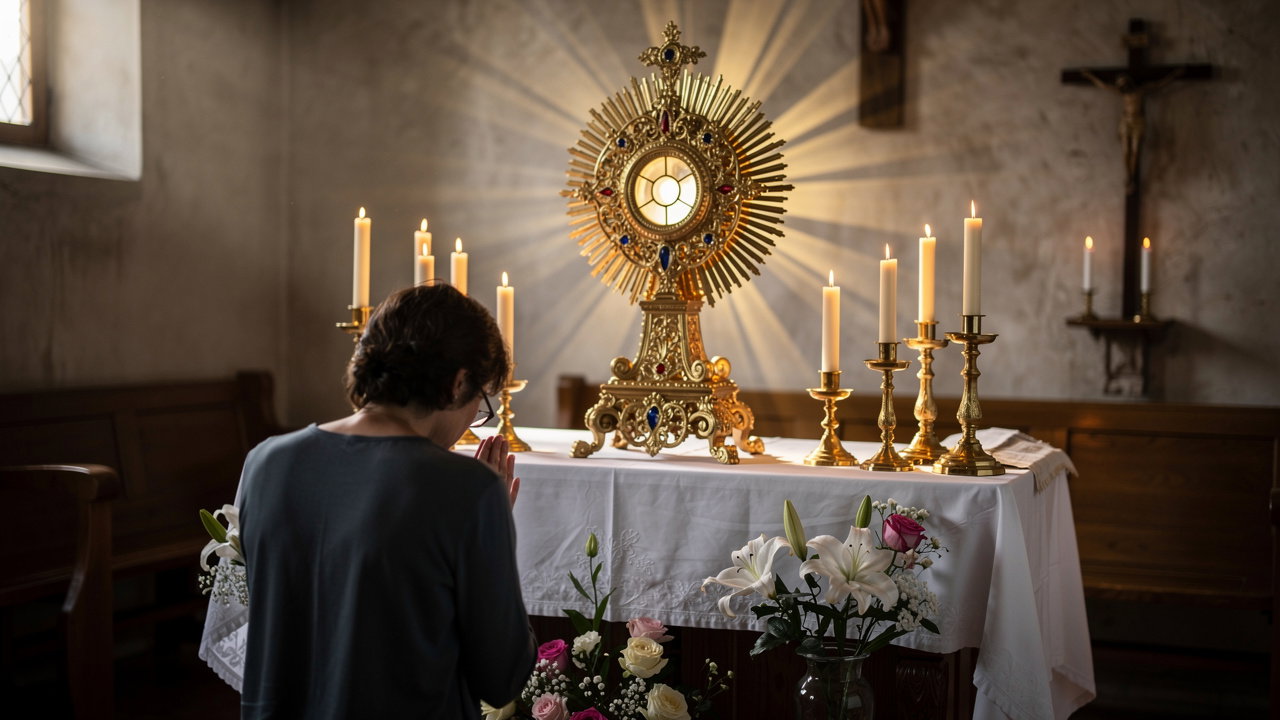
Once we understand the conditions, we can look more closely at some works that carry a plenary indulgence. These are not random. Each one strengthens faith, hope, and charity. They link indulgences to real prayer and charity, not to magical thinking.
Key categories include:
-
Eucharistic devotion
-
At least 30 minutes of adoration before the Blessed Sacrament
-
Joining a solemn Eucharistic procession (for example, on Corpus Christi)
-
-
Sacred Scripture
-
Reading or listening to the Bible for at least 30 minutes with reverence
-
-
Traditional devotions
-
Making the Stations of the Cross at properly erected stations
-
Praying five decades of the Rosary in a church, oratory, family, or prayer group
-
-
Pilgrimage and visits
-
Visiting certain designated holy places on specified feasts (according to the Manual of Indulgences)
-
-
Prayer for the dead
-
Visiting a cemetery and praying for the departed during early November (under the usual conditions)
-
All of these must be joined to the four conditions and the interior detachment from sin to be plenary.
How to Apply Indulgences: For Yourself or for the Souls in Purgatory
An indulgence is always applied in a specific direction. The Church teaches that we can decide, at the time of performing the indulgenced work, how the fruit will be applied.
There are two options:
-
Apply the indulgence to yourself, asking God to remit your own temporal punishment.
-
Offer it for the faithful departed, asking that a soul in Purgatory receive the fruit instead.
In both cases, God remains free in how he applies the grace but respects our intention.
Applying Indulgences to Yourself
When we apply an indulgence to ourselves, we are asking God to heal and purify us more deeply. Even when we live in grace, we still carry many attachments and effects of sin that require purification.
Gaining indulgences for ourselves is part of the call to holiness. It does not replace daily effort, confession, or works of mercy. It supports them, clearing away some temporal punishment that would otherwise remain.
Offering Indulgences for the Holy Souls in Purgatory
We can also offer any indulgence for the souls in Purgatory. In that case, the grace is directed to the departed. This is a profound spiritual work of mercy and a concrete way to live the communion of saints.
We may have a particular person in mind—a parent, friend, or benefactor—and quietly offer the indulgence for that soul. If the person we name is already in Heaven or needs less help, God applies the grace to other souls in need. Nothing offered in charity is wasted.
The month of November is especially devoted to the Holy Souls, but indulgences can be offered for the departed at any time of year.
Special Provisions: When You Cannot Fulfill the Normal Conditions
Life does not always allow us to meet every condition in the usual way. Illness, age, distance, or other serious reasons can keep us from confession, Communion, or the indulgenced work itself. The Church knows this and has made special provisions for those who are truly impeded.
These provisions do not cancel the importance of the normal conditions. They recognize that sometimes an honest impossibility stands in the way. In such cases, the Church can adjust the conditions through her ministers, or God himself supplies what is lacking in view of a person’s faith and charity.
For the Sick, Elderly, and Homebound

Those who are seriously ill, confined to their homes, or limited by age often cannot attend Mass, visit certain places, or complete demanding works. The Church teaches that such people can still gain plenary indulgences if:
-
They are spiritually united with those performing the indulgenced work.
-
They fulfill the conditions as best they can.
This usually means offering their prayers, sufferings, and daily hardships to God with trust. Confessors can “commute” or adjust both the prescribed work and some conditions for those who are impeded. The condition of detachment from sin still remains, since it concerns the heart.
For the sick and homebound, this teaching is a deep comfort. Physical weakness does not limit God’s generosity. United with Christ’s Cross, their hidden suffering can be immensely fruitful.
The Plenary Indulgence at the Moment of Death
There is a very special indulgence offered at the hour of death. The Church teaches that any Catholic who is properly disposed and has been in the habit of prayer during life can gain a plenary indulgence at that moment, even if a priest is not present.
When a priest is at the bedside of the dying, he often gives the Apostolic Blessing, which carries a plenary indulgence. If no priest can come, the Church still intercedes for that person. The usual conditions are supplied by the Church in view of the person’s lifetime of faith and prayer. It is recommended, when possible, to hold or look at a crucifix during this time.
This final indulgence shows God’s mercy at the threshold of eternity. He does not abandon his children in their last hour but surrounds them with help drawn from the whole communion of saints.
Common Misconceptions About Indulgences
Because of past abuses and confusion, indulgences often carry a cloud of misunderstanding. Some of the most common mistakes include:
-
“Indulgences let people buy forgiveness.”The Church has always condemned the selling of spiritual goods as the sin of simony. Indulgences presuppose that the sin has already been forgiven in confession or by perfect contrition. They deal only with temporal punishment, not with guilt, and cannot be bought.
-
“Indulgences get you out of Hell.”Only repentance and confession remove eternal punishment. If a person dies in mortal sin, indulgences cannot help. They are gifts for those who have already come back to God and live in his grace.
-
“Indulgences mean you can sin without fear.”No one can gain an indulgence for a sin they refuse to repent of. Indulgences require conversion, confession, and a sincere turning away from sin.
-
“Indulgences are medieval and the Church no longer teaches this.”The doctrine appears in the current Catechism and Code of Canon Law. It is rooted in Scripture’s teaching on penance, the communion of saints, and prayer for the dead.
-
“‘300 days’ meant 300 days less in Purgatory.”Those numbers referred to ancient public penances on earth, not to time after death. Because this was misunderstood, the Church no longer uses that style of description.
When we set these misconceptions aside and listen to the actual teaching, indulgences appear as a wise and merciful practice.
How Crux Sancta Helps You Understand This Profound Teaching
The doctrine of plenary indulgences touches Scripture, tradition, sacraments, spiritual theology, and Church history all at once. Many Catholics feel either overwhelmed or wary when they approach it. At Crux Sancta, this is exactly the kind of topic we want to explain with patience and clarity.
Our work brings together:
-
Solid theological study
-
Clear, accessible catechesis
-
Real pastoral questions people are asking
We draw from the Catechism, the Manual of Indulgences, and the writings of the saints, then present those teachings in language that thoughtful adults, RCIA candidates, and students can actually use.
We also show how doctrines like indulgences connect to daily discipleship. Rather than treating them as odd extras, we set them within the larger picture of confession, Purgatory, prayer, and the call to holiness. Indulgences appear not as strange add-ons, but as one way God’s mercy is at work through the Church and the communion of saints.
By keeping faith and reason together—and by rooting our work in Scripture and the Church’s living tradition—Crux Sancta seeks to serve those who long for deeper understanding and a stronger faith.
Conclusion
When we bring all these threads together, a plenary indulgence appears as a generous gift woven into the heart of Catholic life. It is the complete remission of temporal punishment for sins already forgiven, granted by the Church from the treasury of Christ and the saints. It does not replace confession or lessen the seriousness of sin. It shows how far God goes to heal the damage sin leaves behind.
We have seen that every sin carries both eternal and temporal consequences, that Purgatory completes the purification needed for Heaven, and that indulgences allow some or all of that purification to take place here. The four conditions for a plenary indulgence, together with the interior detachment from all sin, call us to deep conversion. Grace is a gift, but never a cheap gift; God desires our free response.
At the same time, indulgences open paths of charity. By offering them for the Holy Souls in Purgatory, we share directly in God’s mercy toward those who can no longer merit for themselves. In doing so, we live the communion of saints in a very concrete way.
We do not need to be experts to begin. We can start simply, with one indulgenced work we can honestly perform with devotion, joined to confession, Communion, and prayer for the Pope. Even if our detachment from sin is not yet complete, God uses our efforts to purify us and others. Each sincere attempt matters.
As we continue to learn and practice this teaching, we are drawn more deeply into Christ’s saving work and into the life of his Church. Indulgences are not tricks or shortcuts. They are signs that God wants to heal us completely and bring us, and many others, to share his joy forever.
FAQs
Question 1: Can I Gain Multiple Plenary Indulgences in One Day?
The general rule is that we can gain only one plenary indulgence per day. This shows how deep and complete this grace is meant to be. There is one special exception at the hour of death, when the Church offers a separate plenary indulgence to the dying person who is properly disposed. If we perform several indulgenced works in one day, only one can be plenary, while the others, if done devoutly, can still bring partial indulgences.
Question 2: What Happens If I Don't Fulfill All the Conditions Perfectly?
If one or more of the conditions for a plenary indulgence is not fully met—especially the interior detachment from all sin—the indulgence does not disappear. It becomes a partial indulgence. That still means real remission of temporal punishment and real help for our soul or for the souls in Purgatory. God sees our sincere effort and our desire to love him. With repeated practice and growth in holiness, we may fulfill the conditions more completely over time.
Question 3: How Do I Know What the Pope's Intentions Are When I Pray for Them?
We do not need to know the Pope’s intentions in detail. The Church only asks that we pray for whatever the Holy Father is asking God for on behalf of the Church and the world. A common practice is to pray one Our Father and one Hail Mary with that intention. We can also add general intentions such as the spread of the Gospel, the needs of the poor, and the protection of life.
Question 4: Can I Offer a Plenary Indulgence for a Specific Person in Purgatory?
Yes. We can offer a plenary indulgence for a specific soul in Purgatory, such as a deceased family member or friend. We simply make that intention when performing the indulgenced work and fulfilling the conditions. We should remember that God applies the grace wisely: if that soul is already in Heaven or does not need the full benefit, he uses our offering for other souls in need. No indulgence offered for the dead is ever wasted.
Question 5: Do Indulgences Work Automatically, or Does My Disposition Matter?
Our interior disposition matters very much. Indulgences are not automatic effects tied to outward actions alone. To gain them, we must be in a state of grace and carry out the required acts with faith, humility, and love. The condition of complete detachment from sin shows how much the heart matters. God looks not only at what we do but at why we do it. Even when our devotion is imperfect, he responds to sincere desire and honest effort.
Question 6: Where Can I Find the Complete List of Works That Grant Plenary Indulgences?
The official list of indulgenced works is found in the Manual of Indulgences, published by the Apostolic Penitentiary. Many dioceses and Catholic publishers provide summaries of common indulgences based on this manual. A priest or knowledgeable parish staff member can often point to reliable resources. Once we understand the basic principles laid out here, it becomes easier to read that manual and see how indulgenced works fit into the wider life of prayer and charity.